Vision based— Gesture-Controlled Robotic Finger
Vision-based human-in-the-loop control: MediaPipe gesture → reference mapping → encoder PD → tendon-driven actuation
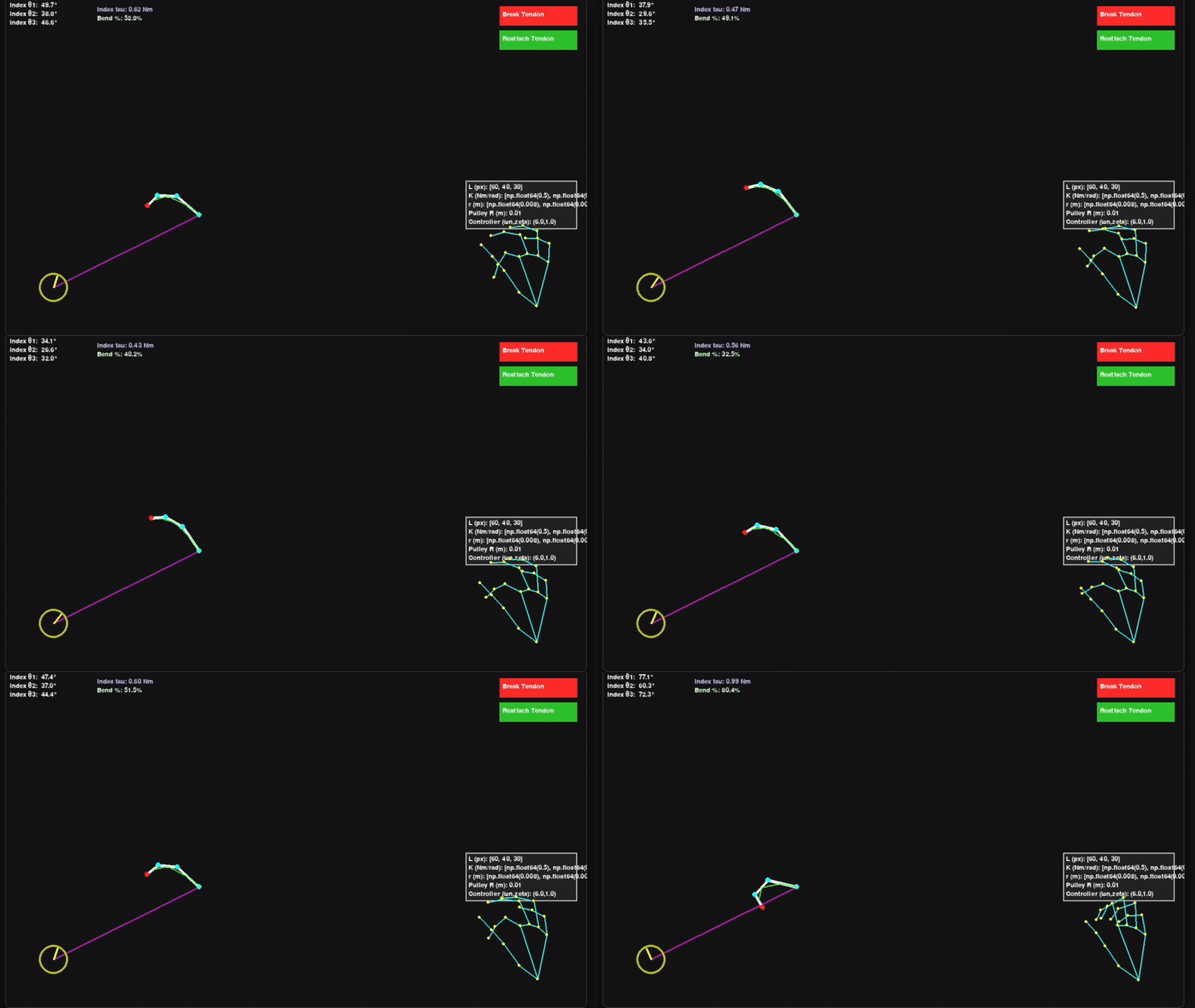
What I built
Built a single-DOF robotic finger that tracks a human finger gesture in real time. A monocular webcam + MediaPipe estimates finger flexion, filters the signal (low-pass + deadband), maps it to a motor reference, and sends commands over serial to an Arduino. The Arduino closes the loop using rotary encoder feedback and a PD controller to drive a DC motor through an H-bridge, actuating a tendon/spool mechanism with elastic return for extension.
Problem
Translate noisy vision-based finger motion into smooth, stable actuator commands for a tendon-driven finger—while maintaining real-time behavior, safe bounds, and reliable tracking with motor-side encoder feedback.
Approach
- Used a webcam + MediaPipe to track 21 hand landmarks and estimate finger bend using inter-segment angles (dot-product geometry).
- Applied signal conditioning (low-pass smoothing + deadband) to suppress jitter and prevent actuator chatter.
- Mapped filtered finger angle to a motor reference angle with scaling + saturation to respect mechanical/electrical limits.
- Implemented a lightweight Arduino firmware loop: receive reference via UART (115200), read encoder, compute error, set motor direction + PWM through an H-bridge.
- Added embedded safety constraints: PWM saturation, reference bounds, and a serial timeout fail-safe.
- Derived a SISO electromechanical plant model for the DC motor + transmission and designed a PD controller for stable tracking.
- Validated control behavior in MATLAB/Simulink before hardware testing (closed-loop step response + Bode analysis).
Engineering decisions
Ownership
- System integration: vision → reference generation → serial protocol → embedded control → electromechanical actuation
- Encoder processing and motor position estimation from counts-per-rev conversion
- PD controller implementation + stability-focused tuning for tendon compliance
- Hardware iteration: tendon routing, spool/encoder alignment, mechanical guards + return mechanism
Results
- Achieved stable, damped closed-loop tracking of gesture-derived reference commands with noise suppression and safety constraints.
- Demonstrated a complete end-to-end pipeline: perception → reference → embedded control → mechanical motion.
- Produced a full engineering report with modeling + Simulink validation prior to hardware execution.